The Space Station is overhead right now.
You could look that up. You won't. Starman will.
Hardware
Precision. Silence.
Personality.
A two-axis tracker with continuous 360° rotation via slip ring, and magnetic encoders that let Starman spring back to its target even if you twist him.
Continuous rotation
A precision slip ring lets Starman spin in either direction, forever. No cable tangles, no end stops.
Magnetic encoders
Twist him mid-track, he snaps right back to target. Because hardware should feel alive, not fragile.
Whisper-quiet
Engineered to sit on your desk, not your garage floor. Smooth, silent, deliberate motion.
The sky is always doing something, and you almost never know what.
Right now the International Space Station is somewhere overhead, orbiting Earth every 93 minutes. Jupiter is rising or setting. A Starlink train is sliding overhead in formation.
All of it is happening over your roof, and none of it reaches you — because knowing means opening an app, and you never will.
Starman closes that gap. You glance at your desk, and you know.
SkyView
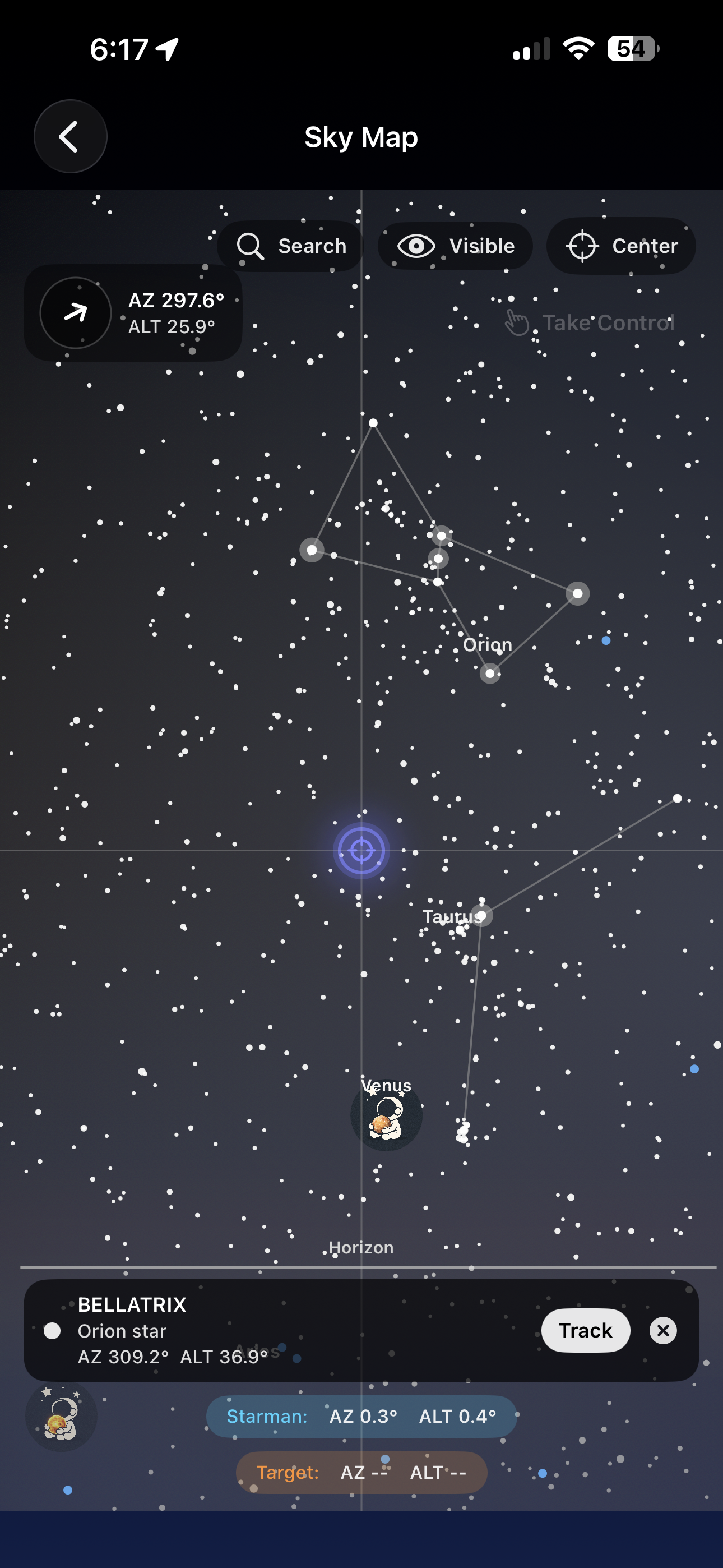
A living map of the night sky.
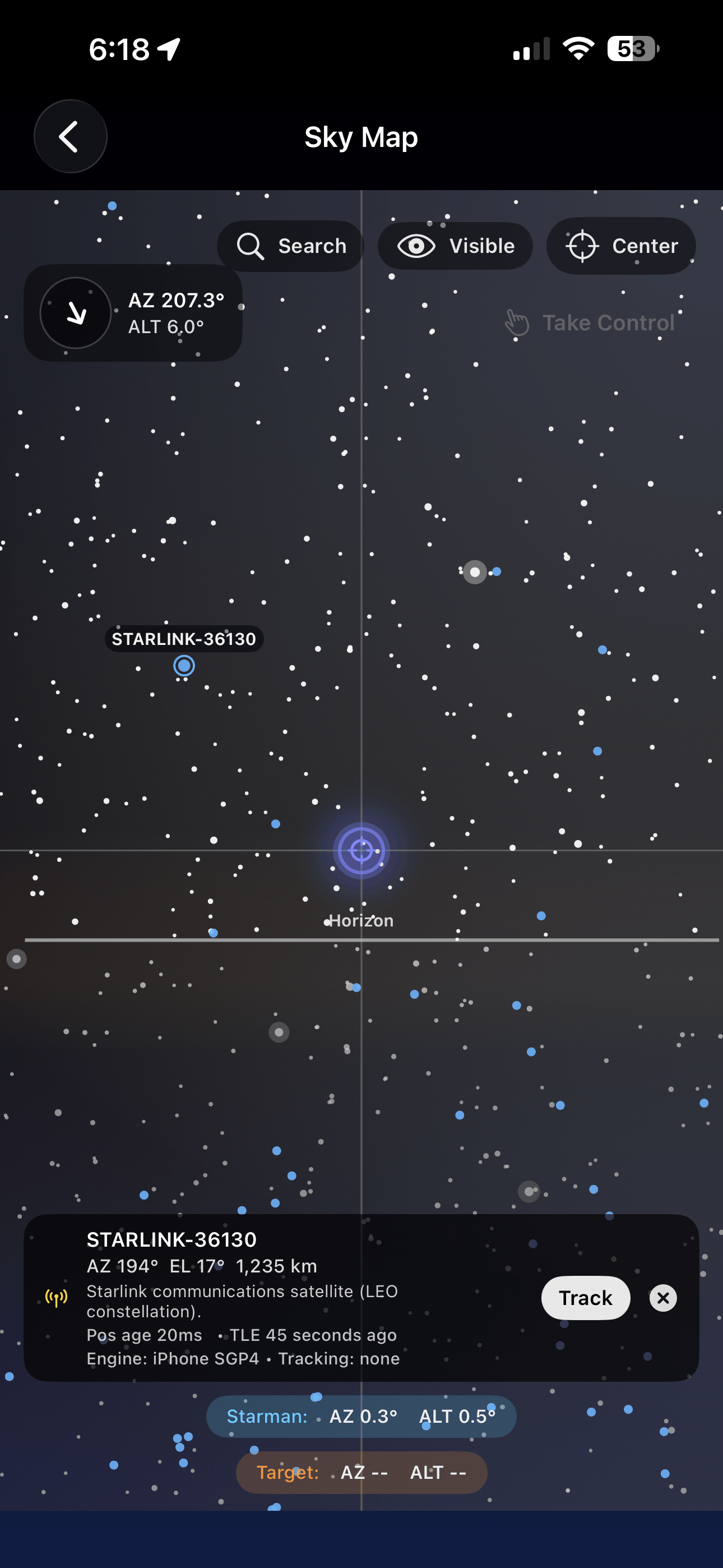
Planets, stars, constellations, and satellites, all live, all above you. Pan the sky, tap a target, and Starman smoothly follows it across the room.
Track anything
From our star to
the edge of the visible.
Planets, stars, deep-sky objects, the ISS, Starlink, the Sun, the Moon. If it's above you, Starman can point at it, even when it's below the horizon, waiting for the rise.
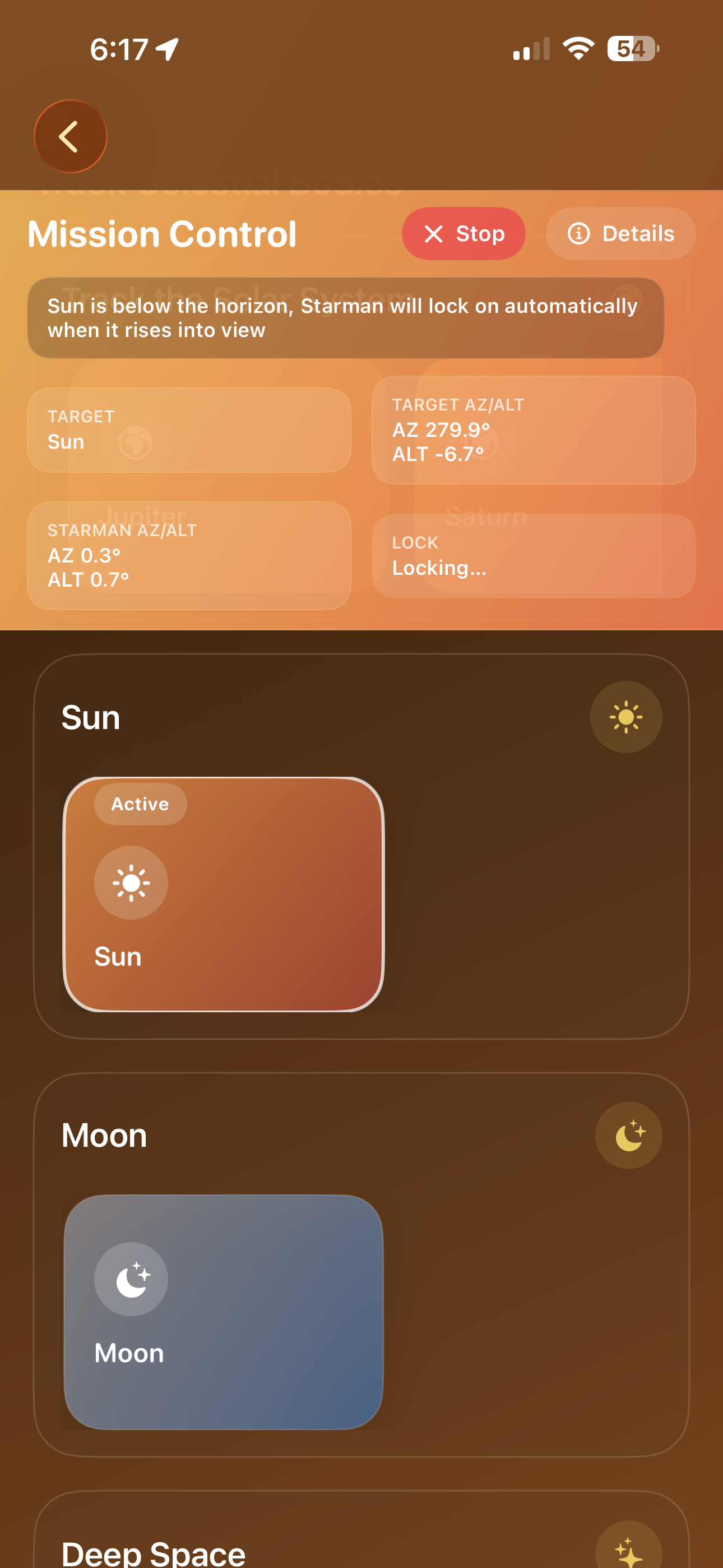
Our star
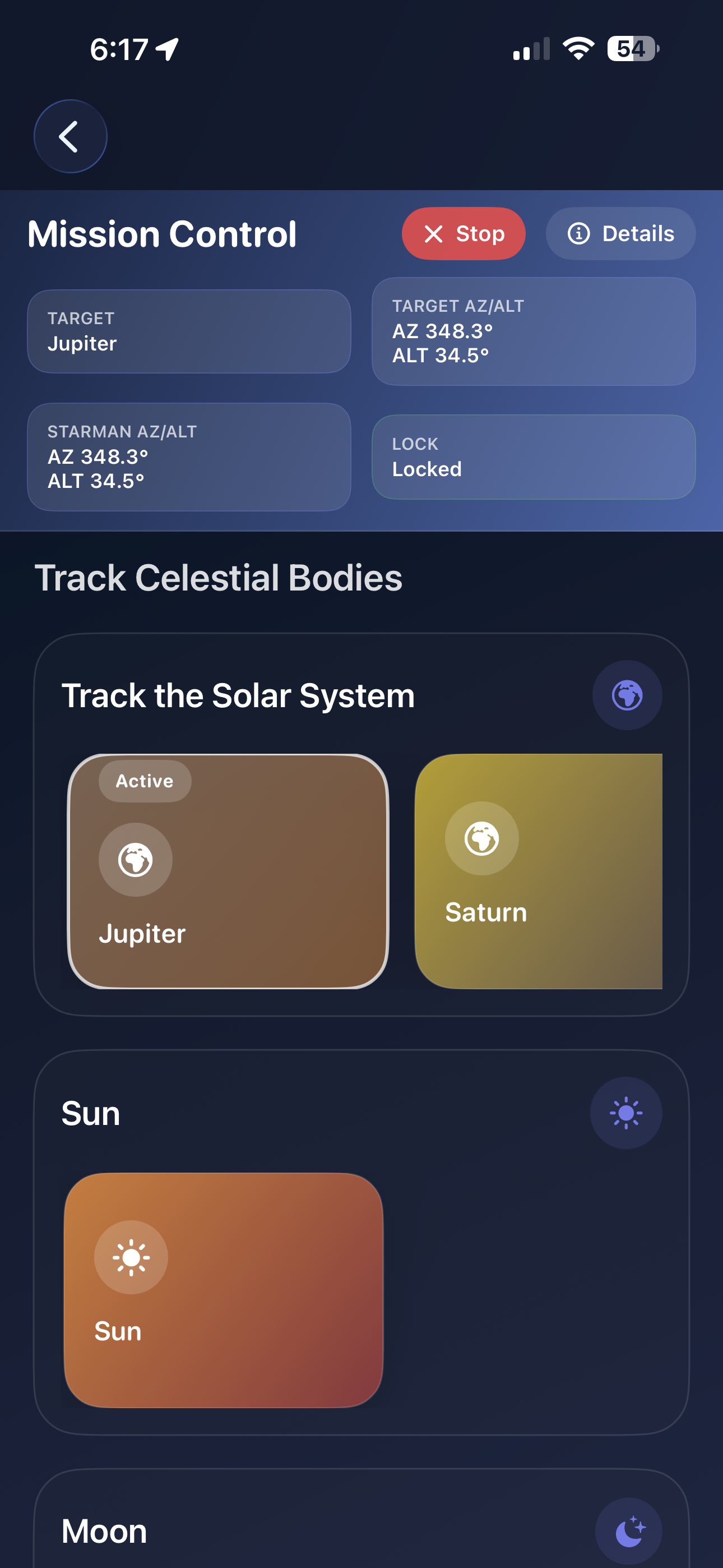
Planets
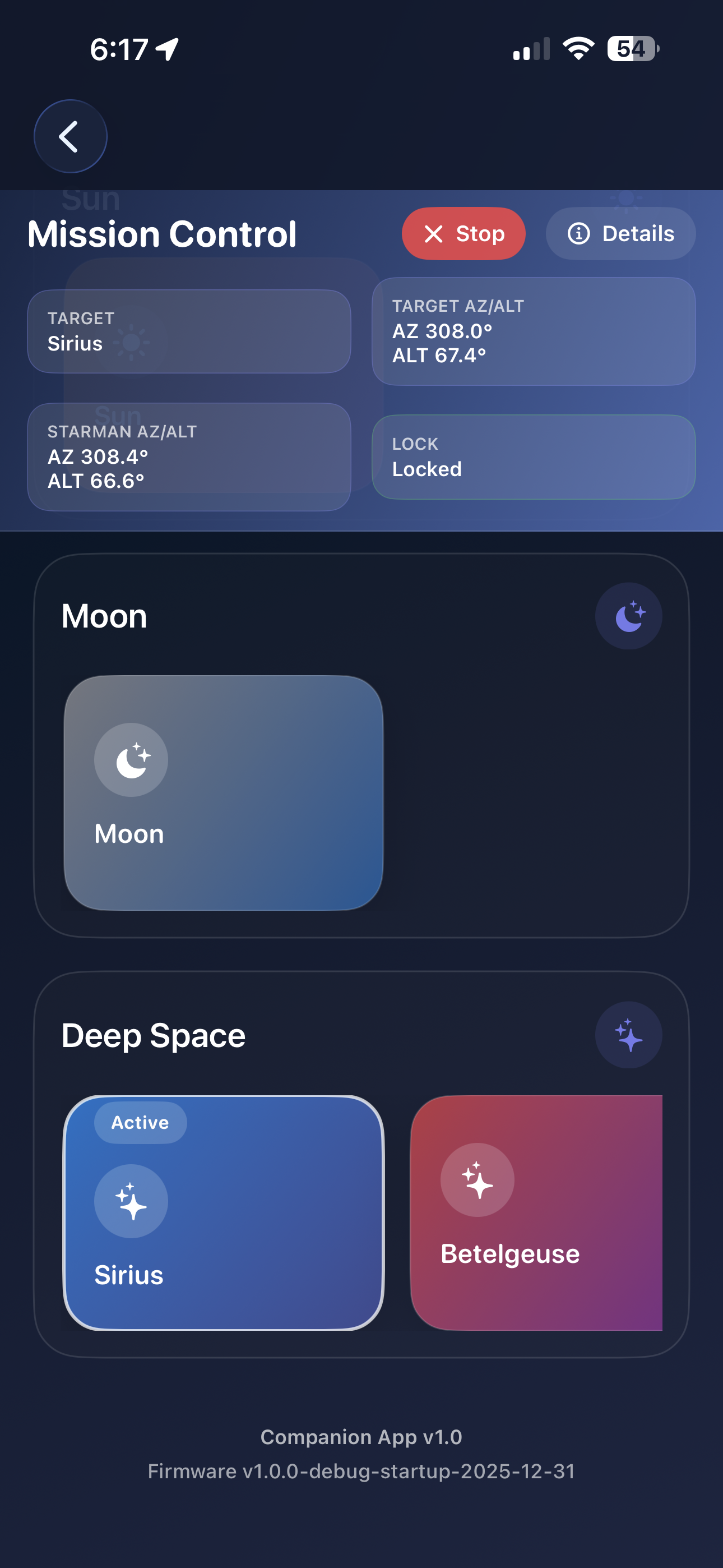
Deep sky
More than an instrument
Fun modes.
Because he's alive.
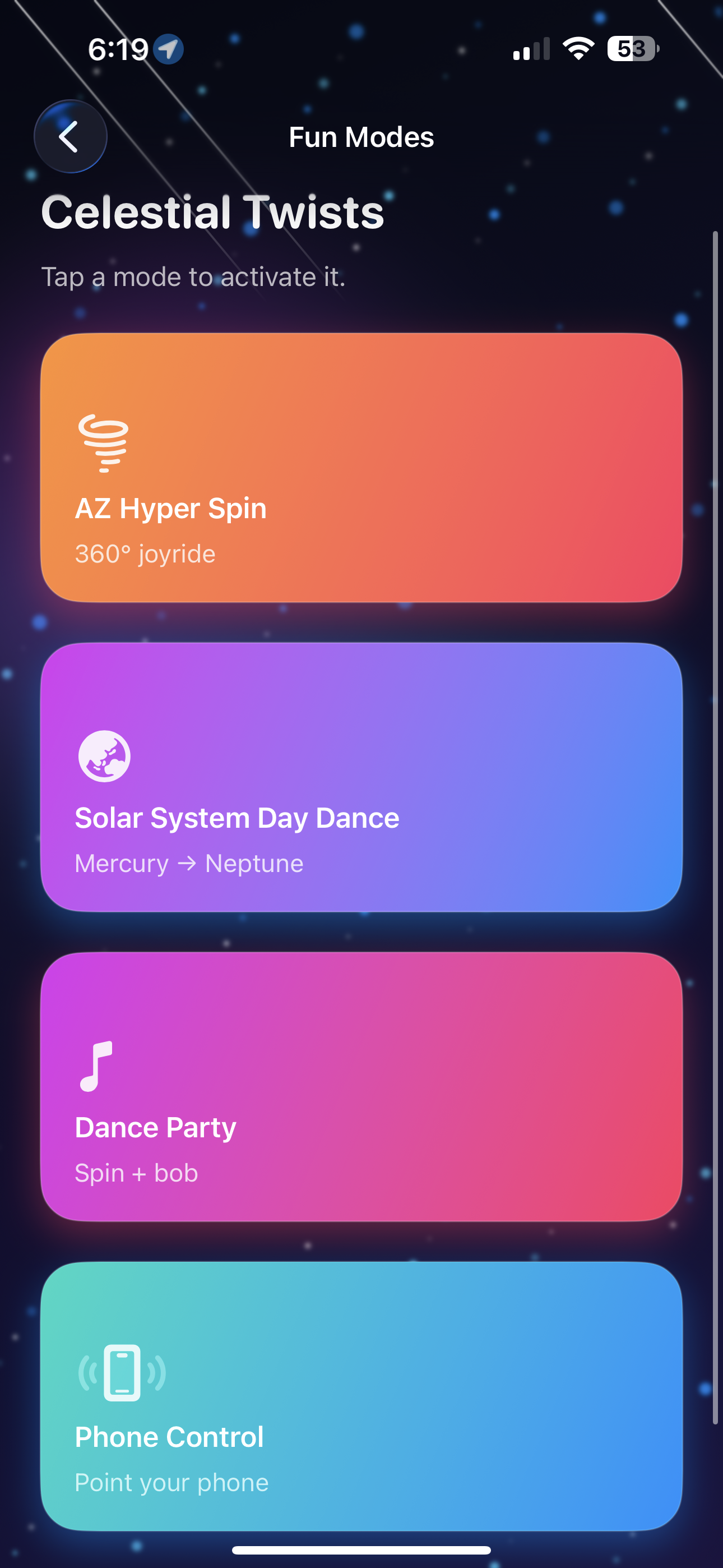
Make Starman dance. Bob his visor. Follow your phone around the room. He's a tracker when you need him, and a companion when you don't.
Collect the sky
Watch long enough,
unlock the set.
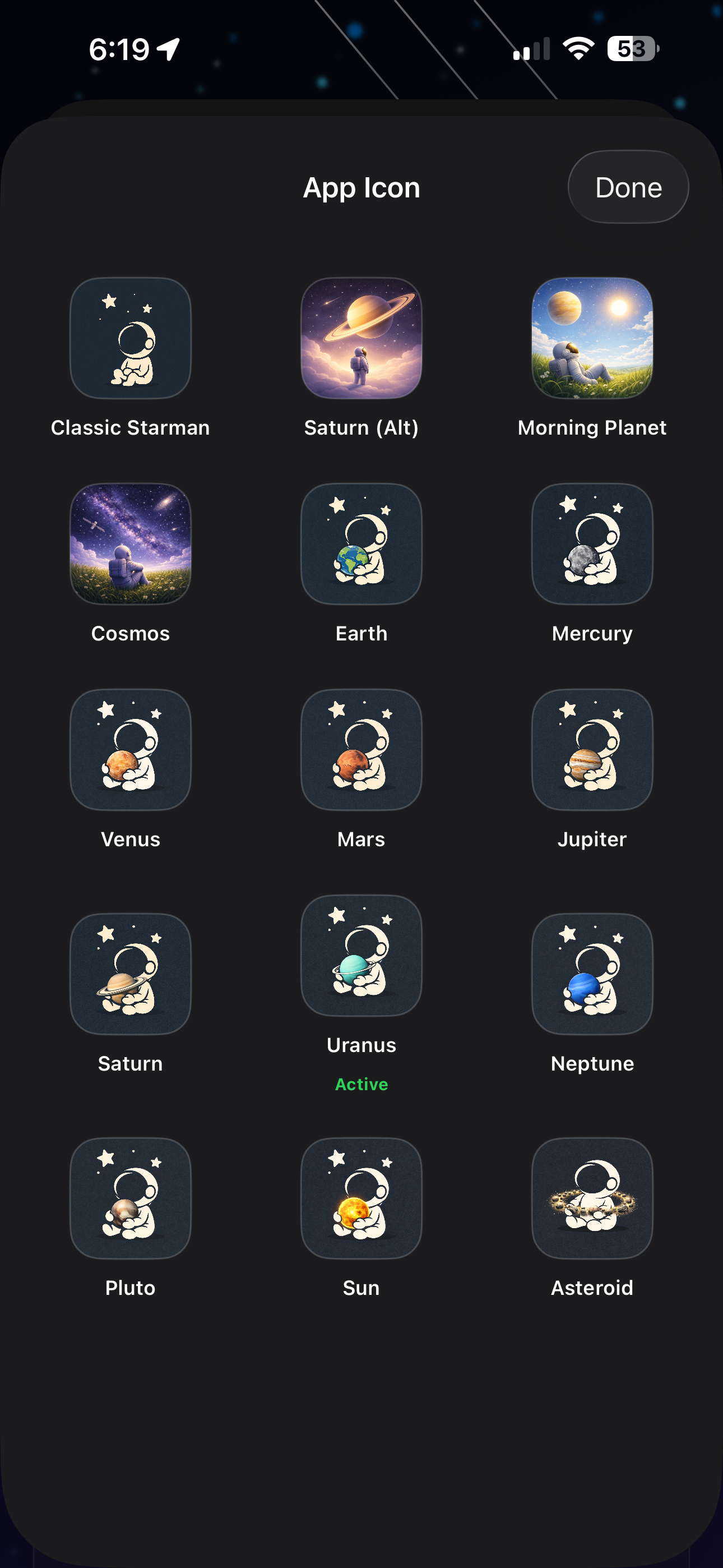
Track Jupiter for an hour. Catch three ISS passes. Follow a full Moon from rise to set. Each milestone unlocks a new app icon, a quiet record of the sky you've shared with Starman.
- Lunar CompanionFull moon tracked
- Planet Hunter5 planets caught
- Starlink Spotter10 satellite passes
- Deep-Sky Devotee1 hour on Sirius
Starbuddy
One tap.
Paired.
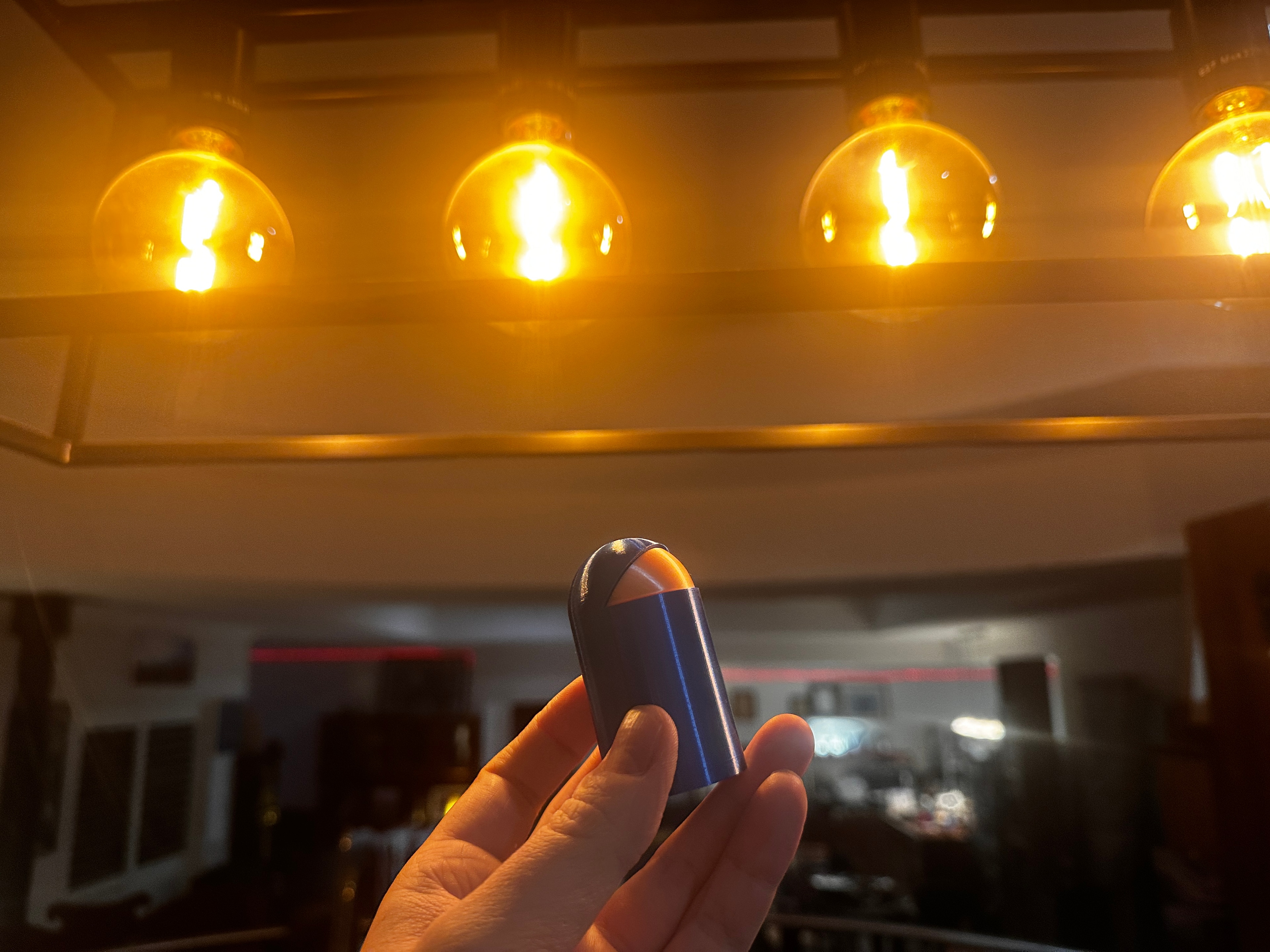
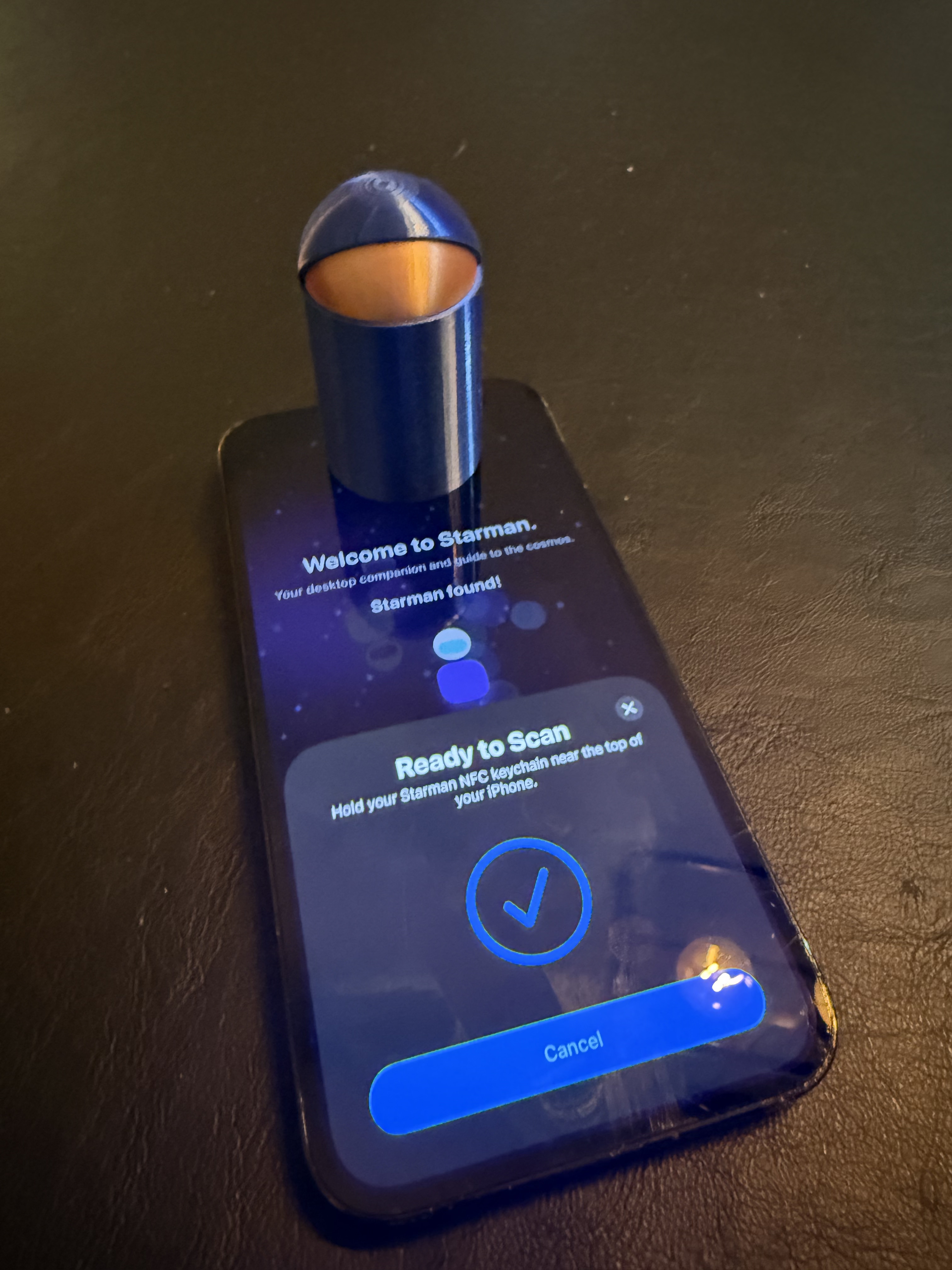
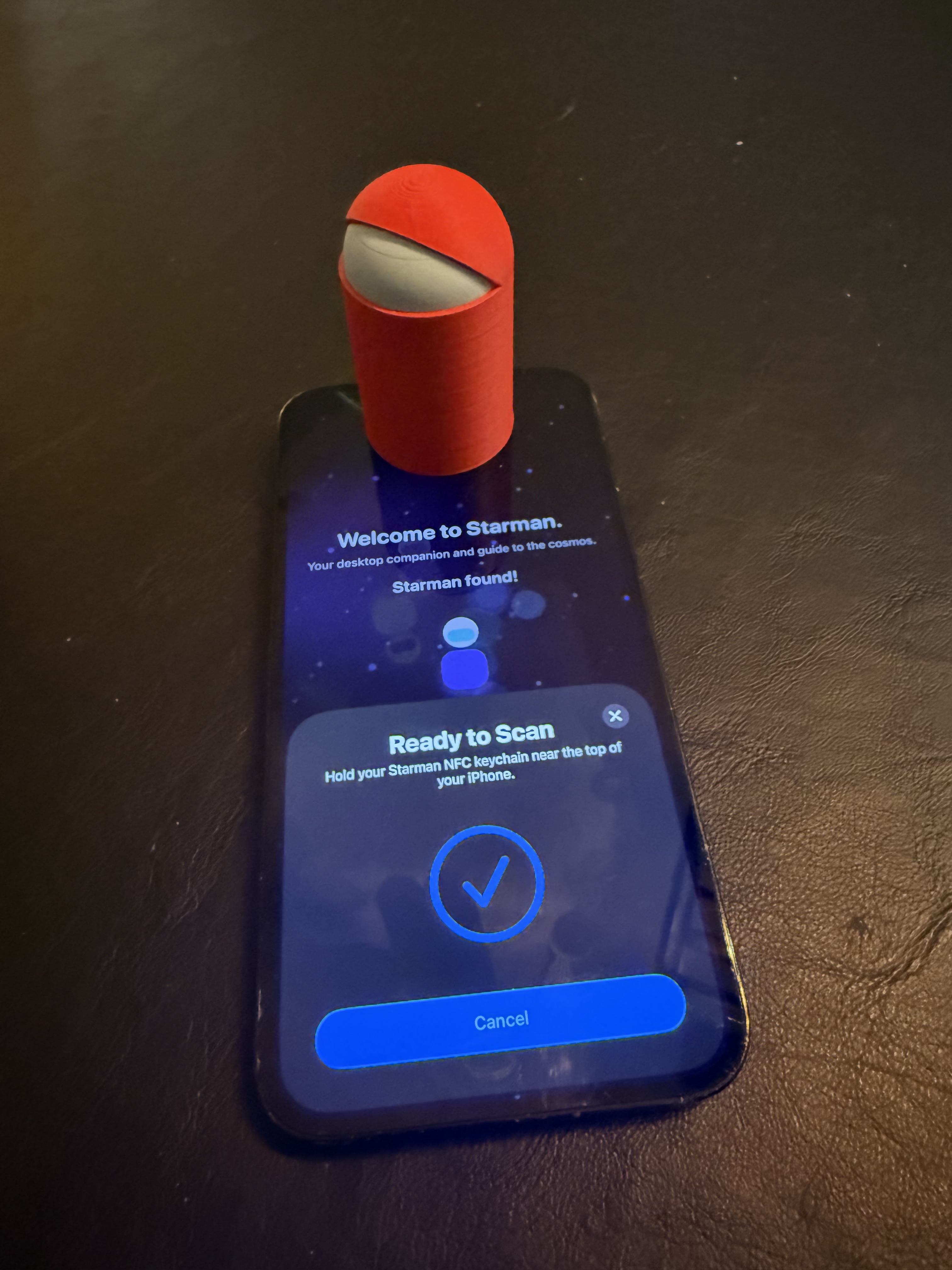
A small NFC keychain that travels with you. Tap it to any Starman and your phone pairs instantly, no menus, no Bluetooth dance. Own a fleet? Each Starbuddy is keyed to its own Starman.
Head, body, and visor, Starman comes in a range of color combinations, each with a matching Starbuddy.
Axes
2
Azimuth + Elevation
Rotation
360°
Continuous via slip ring
Targets
100K+
Planets · stars · satellites
Pairing
NFC
One tap with keychain
About
Designed and engineered in Perth.
Starman is built by Brad Dixon, a design engineer whose work includes the telescope deployment mechanism for ICRAR's TeraNet — the optical ground station network that talks to spacecraft with lasers. Pointing precision instruments at things in orbit is the day job.
IEEE Telepresence Competition
Team lead, WARO32 - 2024 champions. Teleoperated PISCES's Helelani planetary rover across a Mojave Desert course from Perth, 14,800 km away.
Robopalooza 2025
Organiser of the second IEEE Telepresence Competition, held in Perth at the Australian Automation and Robotics Precinct.
Master of Engineering
The University of Western Australia - graduate of UWA's engineering program.
UWA TeraNet
Engineering work on ICRAR's three-node optical ground station network, including TN-3, the world's first fully-mobile optical ground station. Design of the TeraNet jeep mounted telescope deployment mechanism.
Milo Planetary Innovation Challenge - Ecuador
Mentor and team lead for a university student team in the Ecuador challenge delivered by Milo Space Science Institute.
- Brad Dixon, Perth
First batch
The first 25, built by hand.
Before Starman goes to a production run, I'm building 25 of them myself — assembled, calibrated and tested one at a time in Perth. Ordering isn't open yet. Join the list and you'll get first access when it is.
Expected price · 25 in the first batch
- One Starman, assembled and calibrated by hand
- One Starbuddy NFC keychain, keyed to your Starman
- USB-C cable
Ships worldwide from Perth, Western Australia. Free shipping within Australia.
Once these 25 are gone, the next Starmen come from a proper production run. Join the list to hear about it first.
FAQ
Common questions.
How accurate is it?
What if it's cloudy? Or daytime?
Do I need a telescope?
How is it powered?
When can I get one?
What's in the box?
Do I need the app?
Got a question we didn't answer? Reach out at contact@starmanofficial.com.
Launch access
Be first in line.
The hand-built batch is small, and a proper production run comes after it. Drop your email and you'll hear about it before anyone else — along with the occasional look behind the build.
No spam, and never more than once a month.